
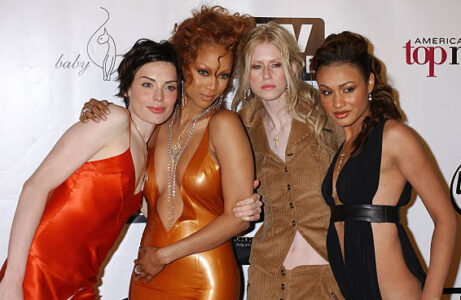
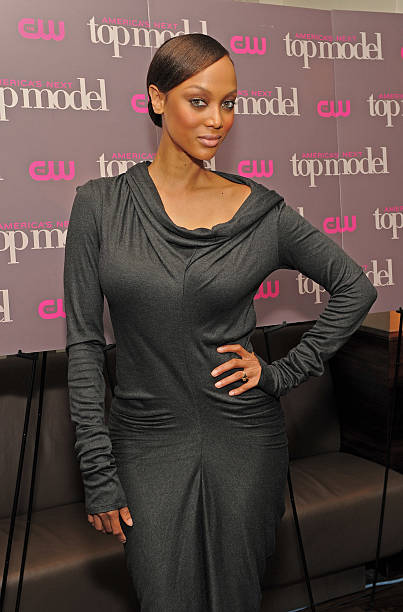
For years, Tyra Banks was one of the most powerful women in fashion and television. She walked major runways in the 1990s, became a Victoria’s Secret Angel, appeared on The Fresh Prince of Bel-Air, and built a media career that expanded beyond modeling. In 2003, she created America’s Next Top Model. She was the host, the creator, and an executive producer. That meant authority. It meant influence over the tone of the show and the environment the contestants entered.
America’s Next Top Model ran for 24 cycles. Young women were placed in a competition where their bodies, personalities, and potential were judged on camera. Weight was discussed openly. Some contestants were labeled “plus-size.” Others were told they were too thin or too commercial. Makeovers were dramatic. Emotional reactions were aired in full. Tyra understands public body scrutiny. On The Tyra Banks Show, after tabloids mocked her weight, she told critics to “kiss my fat ass.” She spoke about how painful it felt to have her body dissected in headlines. That moment became part of her public identity.
Viewers remember that when they rewatch moments from ANTM where contestants were sent home after being told they looked “bigger” in photos. In 2005, during Cycle 4, contestants were told to “switch ethnicities” for a photoshoot. White contestants were darkened with makeup to appear Black and other races. The concept was presented as celebrating diversity. Tyra has said she believed she was highlighting that “Black is beautiful” and did not see the shoot as offensive at the time. Blackface carries a long racist history in the United States. That history was documented long before 2005. The visual of white contestants in darkened makeup exists within that context. Many viewers saw harm in it. Former creative director Jay Manuel has said he felt uncomfortable with the concept when it was proposed. The shoot moved forward. A team approved it. A network aired it.
The Netflix documentary revisits more serious allegations. Former Cycle 2 contestant Shandi Sullivan has said that while filming in Milan she became heavily intoxicated, blacked out, and later woke up with a man on top of her. She has described the experience as sexual assault and has said the footage became part of a cheating storyline rather than being handled as a safety issue. There have been no public criminal charges connected to the claim.F ormer contestant Keenyah Hill has said she felt uncomfortable during a shoot in South Africa when a male model repeatedly touched her without consent. She has said she did not feel protected. Tyra has addressed criticism over the years and has said she has grown. She has also said she did not control every production decision. As creator and executive producer, her role carried weight. The culture of a show reflects its leadership.
At the end of the Netflix documentary, Tyra teases Cycle 25 of America’s Next Top Model, saying viewers have “no idea what we have planned.” There has been no official network confirmation. The tease appears at the close of a documentary filled with former contestants describing emotional harm. Tyra had previously announced that she returned to modeling. She is older. She is not sample size. She is working on her own terms. Contestants on ANTM were judged against strict standards that left very little room for that kind of freedom. The modeling industry is demanding. Contestants were treated as workers but without safety or support. They deserved dignity and respect. Tyra Banks broke barriers as a Black supermodel in an industry that excluded women who looked like her and built a successful television franchise. Yet former contestants have described feeling embarrassed, unsupported, or unsafe under her leadership.
If she brings Cycle 25 forward, the past will still be there. The legacy of America’s Next Top Model now includes these allegations and these decisions. A relaunch does not erase that. New promises about inclusion or change will not make people forget what they watched and viewers remember. What still feels unresolved is accountability. Contestants have spoken and the blame has been placed on production, even though Tyra was the executive producer. Whether she is seen as a visionary or a villain will depend on how history remembers her choices.
By: Sahra Mohamed