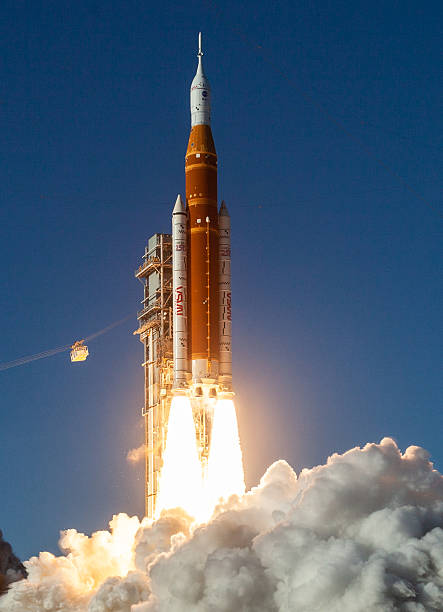

NASA’s Artemis II mission sends astronauts toward the Moon for the first time in more than 50 years. Following Apollo 17, this flight focuses on testing humans and new spacecraft systems for space travel. The mission lasts about 10 days and launches on the Space Launch System (SLS), NASA’s most powerful rocket ever built. Inside the SLS is the Orion spacecraft, built to carry astronauts beyond Earth’s orbit for the first time since the Apollo era. After launch, Orion orbits Earth before firing its engine toward the Moon. The crew then travels hundreds of thousands of kilometers into space. Instead of landing, the spacecraft performs a lunar flyby, looping once around the Moon before returning to Earth. As it passes behind the Moon, communication with Earth is briefly lost, which is expected and part of the mission plan. A key feature of the mission is the free-return trajectory, meaning the spacecraft naturally follows a path back to Earth using the Moon’s gravity. This gives the mission a built-in safety route home.
Safety is a major focus throughout Artemis II. The spacecraft provides oxygen, controls temperature, and protects astronauts from radiation in space. The astronauts wear Orion Crew Survival System suits during launch and landing. These bright orange suits are designed for emergencies and provide oxygen, pressure protection, and communication. They also include a built-in drinking system inside the helmet, along with compact emergency food if needed. Most of the time, the astronauts eat normal pre-packaged meals inside the spacecraft.
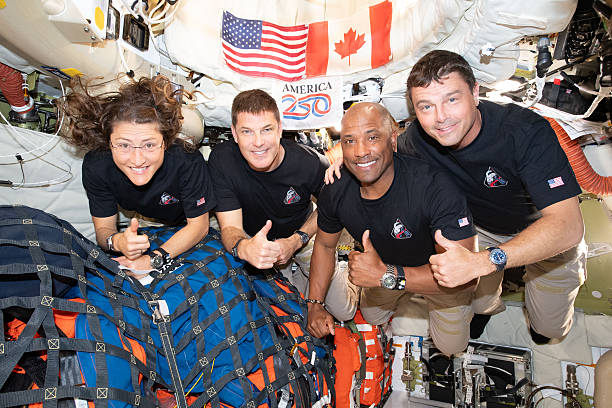
The crew includes Reid Wiseman, Victor Glover, Christina Koch, and Jeremy Hansen of the Canadian Space Agency. Reid Wiseman is a former U.S. Navy test pilot who has lived aboard the International Space Station and previously served as NASA’s Chief of the Astronaut Office. Victor Glover is a U.S. Navy pilot and test pilot who completed long missions on the International Space Station and helped pave the way for future commercial crew flights. Christina Koch is an electrical engineer who spent nearly a year in space on the International Space Station, completing one of the longest single missions by a woman. Jeremy Hansen is a Canadian Space Agency astronaut and former fighter pilot, becoming the first Canadian selected to fly on a lunar mission. During the 10-day mission, the crew tests how the spacecraft performs and how the human body responds to space travel. Every system check helps prepare NASA for future missions to the Moon.
During the return to Earth, the crew inside the Orion spacecraft goes through one of the most intense parts of the mission: reentry. As the spacecraft hits Earth’s atmosphere at extremely high speed, the air in front of it compresses and heats up, creating a glowing plasma fireball around the capsule. Temperatures outside the heat shield reach thousands of degrees, but the spacecraft is designed to protect the crew completely. As Orion slows down during reentry, pressure and heat build up around the spacecraft, while the heat shield absorbs the extreme energy of the descent. Inside the capsule, the astronauts experience strong G-forces as they are pulled back toward Earth. After surviving reentry, Orion deploys its parachutes high above the ocean to slow its descent. The spacecraft then gently lands in the Pacific Ocean. Artemis II shows what it takes to send humans beyond Earth again and safely bring them home.